

Đề thi THPT quốc gia năm 2017 môn Tiếng Anh - Mã đề 404 (Kèm đáp án)
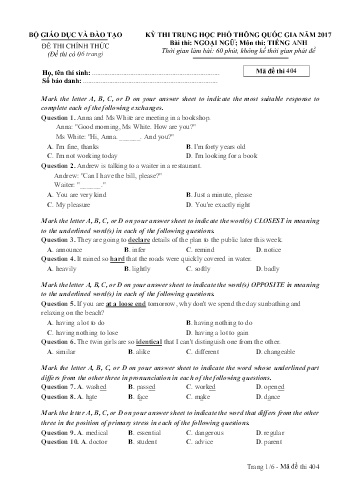
Mark the letter A, B, C, or D on your answer sheet to indicate the most suitable response to complete each of the following exchanges.
Question 1. Anna and Ms White are meeting in a bookshop.
Anna: "Good morning, Ms White. How are you?"
Ms White: "Hi, Anna. ______. And you?"
A. I'm fine, thanks
B. I'm forty years old
C. I'm not working today
D. I'm looking for a book
Question 2. Andrew is talking to a waiter in a restaurant.
Andrew: "Can I have the bill, please?"
Waiter: "______."
A. You are very kind
B. Just a minute, please
C. My pleasure
D. You're exactly right
Question 1. Anna and Ms White are meeting in a bookshop.
Anna: "Good morning, Ms White. How are you?"
Ms White: "Hi, Anna. ______. And you?"
A. I'm fine, thanks
B. I'm forty years old
C. I'm not working today
D. I'm looking for a book
Question 2. Andrew is talking to a waiter in a restaurant.
Andrew: "Can I have the bill, please?"
Waiter: "______."
A. You are very kind
B. Just a minute, please
C. My pleasure
D. You're exactly right
 6 trang
04/04/2024
960
6 trang
04/04/2024
960
Bạn đang xem tài liệu "Đề thi THPT quốc gia năm 2017 môn Tiếng Anh - Mã đề 404 (Kèm đáp án)", để tải tài liệu gốc về máy hãy click vào nút Download ở trên.
Tóm tắt nội dung tài liệu: Đề thi THPT quốc gia năm 2017 môn Tiếng Anh - Mã đề 404 (Kèm đáp án)
C. My pleasure D. You're exactly right
Mark the letter A, B, C, or D on your answer sheet to indicate the word(s) CLOSEST in meaning
to the underlined word(s) in each of the following questions.
Question 3. They are going to declare details of the plan to the public later this week.
A. announce B. infer C. remind D. notice
Question 4. It rained so hard that the roads were quickly covered in water.
A. heavily B. lightly C. softly D. badly
Mark the letter A, B, C, or D on your answer sheet to indicate the word(s) OPPOSITE in meaning
to the underlined word(s) in each of the following questions.
Question 5. If you are at a loose end tomorrow, why don't we spend the day sunbathing and
relaxing on the beach?
A. having a lot to do B. having nothing to do
C. having nothing to lose D. having a lot to gain
Question 6. The twin girls are so identical that I can't distinguish one from the other.
A. similar B. alike C. different D. changeable
Mark the letter A, B, C, or D on your answer sheet to indicate the word whose underlined part
differs from the other three in pronunciation in each of the following questions.
Question 7. A. washed B. passed C. worked D. opened
Question 8. A. hate B. face C. make D. dance
Mark the letter A, B, C, or D on your answer sheet to indicate the word that differs from the other
three in the position of primary stress in each of the following questions.
Question 9. A. medical B. essential C. dangerous D. regular
Question 10. A. doctor B. student C. advice D. parent
Trang 2/6 - Mã đề thi 404
Mark the letter A, B, C, or D on your answer sheet to indicate the correct answer to each of the
following questions.
Question 11. The dog ______ my father gave me is very lovely.
A. who B. when C. which D. where
Question 12. There has been growing public concern about the use of chemicals in food ______
recently.
A. preservation B. protection C. reservation D. conservation
Question 13. Peter bought...______ life is much slower in the country than in the city.
A. an B. a C. Ø D. the
Question 20. The success of the company in such a ______ market is remarkable.
A. compete B. competitively C. competitive D. competition
Question 21. A lot of research in medical science has been ______ to improve human health.
A. made up B. carried out C. taken up D. given off
Question 22. It is important for students to ______ full use of university facilities.
A. take B. do C. find D. make
Read the following passage and mark the letter A, B, C, or D on your answer sheet to indicate the
correct word or phrase that best fits each of the numbered blanks from 23 to 27.
Culture has a strong influence on non-verbal communication. Even the simple act of looking
someone in the eye is not at all that simple. In the USA, Americans are (23)______ to look directly
at people when speaking to them. It shows interest in what they are saying and is thought to carry a
(24)______ of honesty. Meanwhile, in Japan and Korea, people avoid long periods of eye contact.
It is considered more polite to look to the side during a conversation. The Lebanese, (25)______,
stand close together and look intensely into each other's eyes. The action shows sincerity and gives
people a better sense of what their counterparts want.
Given such differences with even the most common expressions, people (26)______ travel or
work abroad have a real need to learn the other culture's body language. People tend to be unaware
of the messages they are sending to others. So, it is (27)______ to consider your own body language
before dealing with people from other cultures. Knowing about the body language of friends, clients,
and colleagues can be very helpful in improving understanding and avoiding miscommunication.
 (Source: Reading Fusion 1 by Andrew E. Bennett)
Trang 3/6 - Mã đề thi 404
Question 23. A. encouraged B. forbidden C. assisted D. opposed
Question 24. A. sound B. sens...mother's parents' names. Similarly, some
people in Eastern Europe name their children after relatives who have died. This tradition is seen as
a means to protect the child from the Angel of Death.
Traditionally in some Asian countries, a child's grandfather or a fortune-teller chooses the
child's name. In contrast to the tradition of naming children after relatives, the child's name is chosen
to influence the child's character. For example, names may be based on a connection to certain
elements such as fire, water, earth, wood, or metal. Or the name might include a written character
meaning beauty, strength, or kindness.
In certain African cultures, when a child is born plays a large part in determining the child's
name. In Ghana's Akan culture, the day a child is born determines the child's name. But each day
has different names for boys and girls. For instance, a boy born on Friday is named Kofi, whereas a
girl born on the same day is named Afua. Both Kofi and Afua mean "wanderer" or "explorer."
Children with these names are seen as travelers.
No matter where the name comes from, a child's name is the first gift in life. Whether the name
is chosen according to preference or dictated by tradition, it reflects something about a child's
culture. For that reason, all names should be treasured and respected.
 (Source: Reading Challenge 2 by Casey Malarcher & Andrea Janzen)
Question 28. What is the main idea of the passage?
 A. The choice of name for a child in Asia
 B. The history of child naming around the world
 C. The practice of child naming in Europe
 D. The tradition of child naming in different cultures
Question 29. According to the passage, in many European cultures, names are typically selected
by ______.
A. ancestors B. parents C. relatives D. grandparents
Question 30. The word "means" in paragraph 2 is closest in meaning to ______.
A. sign B. symbol C. route D. way
Trang 4/6 - Mã đề thi 404
Question 31.
File đính kèm:
- de_thi_thpt_quoc_gia_nam_2017_mon_tieng_anh_ma_de_404_kem_da.pdf
- Dap-an-Tieng-Anh-24-ma-de-K17.pdf

