

Đề thi THPT quốc gia năm 2017 môn Tiếng Anh - Mã đề 401 (Kèm đáp án)
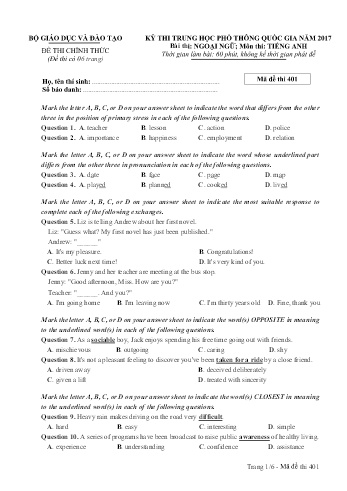
Mark the letter A, B, C, or D on your answer sheet to indicate the word that differs from the other three in the position of primary stress in each of the following questions.
Question 1. A. teacher B. lesson C. action D. police
Question 2. A. importance B. happiness C. employment D. relation
Mark the letter A, B, C, or D on your answer sheet to indicate the word whose underlined part differs from the other three in pronunciation in each of the following questions.
Question 3. A. date B. face C. page D. map
Question 4. A. played B. planned C. cooked D. lived
Question 1. A. teacher B. lesson C. action D. police
Question 2. A. importance B. happiness C. employment D. relation
Mark the letter A, B, C, or D on your answer sheet to indicate the word whose underlined part differs from the other three in pronunciation in each of the following questions.
Question 3. A. date B. face C. page D. map
Question 4. A. played B. planned C. cooked D. lived
 6 trang
04/04/2024
1180
6 trang
04/04/2024
1180
Bạn đang xem tài liệu "Đề thi THPT quốc gia năm 2017 môn Tiếng Anh - Mã đề 401 (Kèm đáp án)", để tải tài liệu gốc về máy hãy click vào nút Download ở trên.
Tóm tắt nội dung tài liệu: Đề thi THPT quốc gia năm 2017 môn Tiếng Anh - Mã đề 401 (Kèm đáp án)
nned C. cooked D. lived
Mark the letter A, B, C, or D on your answer sheet to indicate the most suitable response to
complete each of the following exchanges.
Question 5. Liz is telling Andrew about her first novel.
 Liz: "Guess what? My first novel has just been published."
 Andrew: "______"
A. It's my pleasure. B. Congratulations!
C. Better luck next time! D. It's very kind of you.
Question 6. Jenny and her teacher are meeting at the bus stop.
 Jenny: "Good afternoon, Miss. How are you?"
 Teacher: "______. And you?"
A. I'm going home B. I'm leaving now C. I'm thirty years old D. Fine, thank you
Mark the letter A, B, C, or D on your answer sheet to indicate the word(s) OPPOSITE in meaning
to the underlined word(s) in each of the following questions.
Question 7. As a sociable boy, Jack enjoys spending his free time going out with friends.
A. mischievous B. outgoing C. caring D. shy
Question 8. It's not a pleasant feeling to discover you've been taken for a ride by a close friend.
A. driven away B. deceived deliberately
C. given a lift D. treated with sincerity
Mark the letter A, B, C, or D on your answer sheet to indicate the word(s) CLOSEST in meaning
to the underlined word(s) in each of the following questions.
Question 9. Heavy rain makes driving on the road very difficult.
A. hard B. easy C. interesting D. simple
Question 10. A series of programs have been broadcast to raise public awareness of healthy living.
A. experience B. understanding C. confidence D. assistance
Trang 2/6 - Mã đề thi 401
Mark the letter A, B, C, or D on your answer sheet to indicate the correct answer to each of the
following questions.
Question 11. It is not always easy to make a good ______ at the last minute.
A. decide B. decision C. decisive D. decisively
Question 12. Mr Brown has kindly agreed to spare us some of his ______ time to answer our questions.
A. valuable B. worthy C. costly D. beneficial
Question 13. More and m...r and intends to buy a new one.
A. black old Japanese B. Japanese old black C. old black Japanese D. old Japanese black
Question 21. You ______ use your mobile phone during the test. It's against the rules.
A. mightn't B. mustn't C. oughtn't D. needn't
Question 22. A university degree is considered to be a ______ for entry into most professions.
A. demand B. requisite C. claim D. request
Read the following passage and mark the letter A, B, C, or D on your answer sheet to indicate the
correct word or phrase that best fits each of the numbered blanks from 23 to 27.
In the early twentieth century, an American woman named Emily Post wrote a book on
etiquette. This book explained the proper behavior Americans should follow in many different social
(23)______, from birthday parties to funerals. But in modern society, it is not simply to know the
proper rules for behavior in your own country. It is necessary for people (24)______ work or travel
abroad to understand the rules of etiquette in other cultures as well.
Cultural (25)______ can be found in such simple processes as giving or receiving a gift. In
Western cultures, a gift can be given to the receiver with relatively little ceremony. When a gift is
offered, the receiver usually takes the gift and expresses his or her thanks. (26)______, in some
Asian countries, the act of gift-giving may appear confusing to Westerners. In Chinese culture, both
the giver and receiver understand that the receiver will typically refuse to take the gift several times
before he or she finally accepts it. In addition, to (27)______ respect for the receiver, it is common
in several Asian cultures to use both hands when offering a gift to another person.
(Source: Reading Advantage by Casey Malarcher)
Trang 3/6 - Mã đề thi 401
Question 23. A. positions B. conditions C. situations D. locations
Question 24. A. who B. which C. where D. whose
Question 25. A. differences B. different C. differently D...and are considered guardian
angels of the people. Tradition says that the new tooth will grow good and strong if the baby tooth
is fed to a guardian angel. Accordingly, parents in Mongolia will put their child's lost tooth in a piece
of meat and feed it to a dog.
The idea of giving lost teeth to an angel or fairy is also a tradition in the West. Many children
in Western countries count on the Tooth Fairy to leave money or presents in exchange for a tooth.
The exact origins of the Tooth Fairy are a mystery, although the story probably began in England
or Ireland centuries ago. According to tradition, a child puts a lost tooth under his or her pillow
before going to bed. In the wee hours, while the child is sleeping, the Tooth Fairy takes the tooth
and leaves something else under the pillow. In France, the Tooth Fairy leaves a small gift. In the
United States, however, the Tooth Fairy usually leaves money. These days, the rate is $1 to $5 per
tooth, adding up to a lot of money from the Tooth Fairy!
(Source: Reading Challenge 2 by Casey Malarcher & Andrea Janzen)
Question 28. What is the passage mainly about?
A. Traditions concerning children's lost teeth B. Presents for young children's lost teeth
C. Animals eating children's lost teeth D. Customs concerning children's new teeth
Question 29. The word "their" in paragraph 1 refers to ______.
A. houses' B. roofs' C. children's D. countries'
Question 30. According to the passage, where is a child's lost tooth thought to be taken away by a mouse?
A. In Mexico and Spain B. In Mongolia
C. In Japan and Vietnam D. In Korea
Question 31. According to paragraph 2, parents in Mongolia feed their child's lost tooth to a dog
because ______.
 A. they know that dogs are very responsible animals
 B. they believe that this will make their child's new tooth good and strong
 C. they think dogs like eating children's teeth
 D. they hope that their child will get some gifts for his or her
File đính kèm:
- de_thi_thpt_quoc_gia_nam_2017_mon_tieng_anh_ma_de_401_kem_da.pdf
- Dap-an-Tieng-Anh-24-ma-de-K17.pdf

